
Eco-Anxiety and Its Behavioral Manifestations: A Systematic Scoping Review
Abhinav Atri
*
 and Supriya Srivastava
1
School of Behavioral and Social Sciences,
Manav Rachna International Institute of Research Studies,
Faridabad,
Haryana
India
http://dx.doi.org/10.12944/CWE.21.1.7
Copy the following to cite this article:
Atri A, Srivastava S. Eco-Anxiety and Its Behavioral Manifestations: A Systematic Scoping Review. Curr World Environ 2026;21(1). DOI:http://dx.doi.org/10.12944/CWE.21.1.7
Copy the following to cite this URL:
Atri A, Srivastava S. Eco-Anxiety and Its Behavioral Manifestations: A Systematic Scoping Review. Curr World Environ 2026;21(1).
Download article (pdf)
Citation Manager
Publish History

Introduction
Global health and natural ecosystems are expected to be at risk due to climate change (CC) starting about 2040, depending on the extent of global warming.1 The Earth's rapid warming brings significant and widespread challenges, extending beyond environmental and structural impacts to deeply influence human psychology. As temperatures rise, ecosystems deteriorate, and extreme weather events intensify, individuals are increasingly burdened by uncertainty and vulnerability. This phenomenon has given rise to a growing body of literature examining the psychological consequences of CC, with particular emphasis on its effects on mental health and emotional well-being. Among these, anxiety, depression, and stress are identified as common responses to the pervasive threat posed by a warming planet.
Human health is affected by climate change in three ways: indirectly (economic ramifications, migration, damage to physical and social infrastructure, food and water shortages, and conflict), directly (repercussions of extreme acute weather events), and vicariously (many people feel distressed just by knowing about the global environmental crisis, even if they have not experienced the direct or indirect effects of climate change).2 Indirect effects include shifts in the geographic distribution of infectious diseases, poor nutrition and water quality, food and economic hardship, forced migration, and mental health risks.3 Due to causes like malnutrition, malaria, diarrhea, and heat stress, CC is estimated to result in about 250,000 deaths every year, making it one of the most urgent global health issues of the twenty-first century. Even though the immediate repercussions of CC include increased premature mortality from respiratory and cardiovascular disease, food and water-borne infections, and starvation, an increasing number of research increasingly concentrating on the direct implications on mental health.5
The effects of CC on public health are profoundly intertwined with social and economic inequalities, disproportionately impacting vulnerable populations. The increased frequency, intensity, and duration of weather-related stressors disrupt key aspects of daily life, including employment, education, and housing stability, thereby exacerbating existing disparities. These could be subacute (like water scarcity), chronic (like increasing sea levels, shifting ecosystems and landscapes), or acute (like storms, wildfires, and heatwaves).4,5 Exposure to these events contributes to job losses, school closures, homelessness, and forced migration, all of which have an impact on various facets of everyday life and functioning.6 Understanding these interconnected impacts is essential for addressing the broader implications of climate change, particularly its influence on mental health and well-being. As we move forward, it becomes critical to examine eco-anxiety as a psychological response to these disruptions and explore how it shapes individual and collective behavioral adaptations.
Gaps in the current literature
Characterized by a deep and pervasive fear of environmental destruction, eco-anxiety significantly influences individual behaviors. Acting as a powerful motivator, it drives individuals to re-evaluate their lifestyles and engage in actions aimed at mitigating climate change. However, the literature often overlooks the nuanced and diverse ways in which eco-anxiety translates into behavioral changes. While eco-anxiety can motivate pro-environmental actions, it can also lead to maladaptive coping mechanisms. Research has indicated that people with high levels of eco-anxiety may intentionally or inadvertently steer clear of information on climate change, which limits their comprehension of the problem and prevents them from taking appropriate action. On the other hand, some individuals may deny the severity of climate change or downplay its impact, leading to a sense of helplessness and inaction.
Eco-anxiety leads to feelings of despair and hopelessness, prompting individuals to withdraw from social engagement and disengage from societal issues, including environmental concerns. Furthermore, the literature often focuses on specific populations, such as young people or climate activists, neglecting the diverse range of behavioral responses across different demographics and socio-cultural contexts. This limited focus hinders a comprehensive understanding of how eco-anxiety manifests and influences behavior in various groups, including marginalized communities and individuals from low-income backgrounds.
While negative impacts are prevalent, eco-anxiety also motivates positive behavioral changes. Individuals may engage in a range of pro-environmental actions and adopt sustainable practices, such as reducing consumption, minimizing waste, and transitioning to renewable energy sources. Studies also show an increase in civic engagement by participating in environmental activism, supporting environmental organizations, and advocating for climate policies. People also engage in local initiatives, such as community gardens, tree planting programs, and environmental education programs. Given this double-sided effect of eco-anxiety on individual and group behavior, it is crucial to understand the underlying factors that cause this variation.
Research has yet to fully elucidate the factors that mediate the relationship between eco-anxiety and these diverse behavioral responses. Understanding the psychological, social, and environmental factors that influence how individuals cope with eco-anxiety is crucial. Future studies should investigate individual factors such as personality traits, coping mechanisms, perceived control, and risk perception. Focusing on group behavior, studies should take into consideration the impacts of social support networks, cultural norms, and community engagement opportunities. Finally, environmental factors such as exposure to environmental disasters, access to green spaces, and the availability of sustainable resources should also be studied as important mediating factors. By investigating these mediating factors, researchers can gain a deeper understanding of the complex interplay between eco-anxiety and behavior, which is essential for developing effective interventions and promoting positive climate action.
Review question
Understanding the diverse range of behavioral responses to eco-anxiety is crucial for several reasons. Firstly, it allows us to recognize that eco-anxiety, while a significant psychological challenge, can manifest in various ways, extending beyond simple feelings of fear and distress. These responses can range from constructive engagement with environmental issues, such as activism and lifestyle changes, to maladaptive coping mechanisms that can negatively impact individual well-being and hinder effective climate action.
Secondly, by identifying and understanding these different types of responses, we can gain valuable insights into the psychological and social processes that underlie individual coping mechanisms in the face of environmental threats. This knowledge can inform the development of effective interventions and support systems for individuals experiencing eco-anxiety, helping them to navigate these challenging emotions and engage in constructive action.
Finally, examining the spectrum of behavioral responses to eco-anxiety can provide valuable information for policymakers and environmental organizations. By understanding the factors that drive different types of responses, we can develop more effective strategies for promoting pro-environmental behavior and fostering collective action on climate change.
Given the significance of these issues, this scoping review will address the following key question:
What are the adaptive and maladaptive behavioral responses to eco-anxiety?
This overarching question will guide the investigation into the diverse range of behavioral responses observed in individuals experiencing eco-anxiety, encompassing both constructive engagement with environmental issues and potentially detrimental responses that may hinder individual well-being and effective climate action.
Systematic scoping review
Scoping reviews uncover any gaps in a particular study issue and provide a comprehensive summary of existing research findings.7 When researchers don't have the time or resources to conduct a more thorough systematic evaluation, these reviews are especially helpful.7 Finding, evaluating, and synthesizing all relevant publications on a particular problem in order to find answers is the specific emphasis of systematic reviews.7,8 In order to find solutions to particular queries from a large amount of peer-reviewed literature, the current paper combines the two methods. This work employs the five components of the six-step method outlined by Arksey and O'Malley (2005) to scope, identify, and expound upon the key concepts found in the corpus of research on the connection between loneliness and wellbeing. The steps are as follows: (a) determining the research subject; (b) locating pertinent studies; (c) choosing a study; (d) analyzing and synthesizing qualitative data; and (e) summarizing and reporting the findings. The sixth step, ‘consultation exercise’, being an optional component of the scoping study framework,7 will not be included in the present review. This strategy will offer a framework for answering the questions posed by the current review. The search tactics will then be explained in detail prior to the results being displayed.
Understanding eco-anxiety
Eco-anxiety, defined as a persistent fear of environmental destruction and its effects on current and future generations, is a pressing mental health issue, emerging in response to the ongoing climate crisis.9 This state of hopelessness, fear, and uncertainty can also be linked to the growing awareness of ecological decline, dissatisfaction with societal efforts to address the crisis, and uncertainty about the future. For many, the heightened awareness of CC's damaging and irreversible impacts can become paralyzing and affect their ability to maintain routine activities and long-term planning, which also leads to the condition of eco-anxiety.
Eco-anxiety manifests through a variety of psychological and physiological indicators, highlighting its wide-ranging impact on mental health. Symptoms include insomnia, panic attacks, obsessive thoughts, depressive episodes, appetite loss, and, in extreme situations, self-harm have been reported by researchers.10-13 One of the more alarming societal effects of eco-anxiety is its influence on family planning. A growing number of individuals, especially younger generations, report hesitation or outright refusal to have children due to fears about the future of the planet. This reluctance is driven by the belief that future generations will inherit a world increasingly marked by environmental degradation and instability.12 These choices highlight the far-reaching effects of eco-anxiety, which not only affects mental health but also modifies demographic trends and larger societal patterns in ways that represent the severe psychological cost of living under the shadow of climate change.
Developing as a serious mental health issue, eco-anxiety draws attention to the complex relationships that exist between environmental deterioration, public health, and psychological health. The mental toll that CC takes—especially on vulnerable populations—becomes more apparent as it intensifies social, economic, and environmental disturbances. The appearance of eco-anxiety, with its vast spectrum of symptoms, emphasizes the deep emotional burden of living in a world increasingly afflicted by climate instability. In addition to its psychological effects on individuals, eco-anxiety also affects group behaviors, such as family planning decisions, which change the dynamics of society. Addressing eco-anxiety requires both immediate action on climate change mitigation and targeted mental health interventions to support those struggling to cope with the uncertainty of the future. Without these efforts, the emotional and societal toll of eco-anxiety will likely continue to grow in parallel with the worsening climate crisis.
Methodology
Using the well-known six-step method described by Arksey and O'Malley (2005), the researchers mapped out the following steps to locate relevant publications to include in the review. As previously stated, we adhered to five of the six steps in the framework, except for the sixth, known as the "consultation exercise," which is considered an optional part of the scoping study framework.7
Identifying the research question
Using a broad perspective, scoping reviews are carried out to give a comprehensive assessment of the present state of knowledge on a specific topic.7,14 We developed the following general research question in light of the goals of this comprehensive scoping investigation.: What are some of the adaptive and maladaptive behavioral reactions to eco-anxiety? We aimed to identify the various behavioral reactions to eco-anxiety through this process. We also tried to talk about whether these are maladaptive or adaptive. Several keywords were used to identify relevant studies, such as Eco-anxiety, Climate change, Eco-emotions, Behavioral impact of climate change, and Climate psychology.
Finding pertinent research
The search for the pertinent works was conducted using a variety of sources since scoping reviews are thorough. Specialized and interdisciplinary electronic databases, including APA PsycINFO, Scopus, Taylor and Francis, Elsevier, Google Scholar, and Springer, were used in this review to provide sufficient and effective coverage. Intervention studies, literature reviews, and systematic reviews were not included. Checking the reference lists of every included paper was one of the additional searches. To find later articles, we also conducted citation searches of important publications.
Selection of studies
Both researchers conducted separate searches for pertinent literature, and their examination of the literature produced a significant number of unrelated studies. Conclusions and additional eligibility criteria were determined through discussions based on the first reviewed papers. As the research went on and we gained more knowledge about the corpus of current work, these criteria were improved.
Eligibility
The impact of eco-anxiety had to be reported as either an independent variable (IV; variable that could be the cause of a behavior or an outcome) or a dependent variable (DV; the outcome variable that depends on the IV) in order for the paper to be included in the review. Only full-text, qualitative, or quantitative studies published in peer-reviewed English-language journals within the previous ten years were eligible. The impact of climate change on psychological and mental health can be observed during a 10-year period, which was chosen due to the growth in climate change studies. Additionally, the ten-year duration would guarantee that the data gleaned from the studies would still be applicable today.7
The review concentrated on including all age categories in the study because many studies on eco-anxiety have already concentrated on the younger population (15) and there are few studies looking at the experience of eco-anxiety among other age groups. Because the researchers wished to look into eco-anxiety as a reaction to climate change, papers that used samples with pre-existing mental health conditions were not included.
Data extraction and collection
No formal methodological quality assessment or risk-of-bias tool was applied, as the aim was conceptual synthesis rather than effect size estimation. However, study design, sample characteristics, and measurement approaches were considered during interpretation. A database search produced 212 papers in total; 141 items remained for screening after duplicates (n = 71) were eliminated. The inclusion and exclusion criteria were further improved, clarified, and made more obvious before the screening process began. Reviewers then moved on to abstract screening. 71 articles were found for full-text review once the eligibility criteria were applied. Both reviewers reread articles that they disagreed on and debated their applicability. Fifty papers were ultimately kept for the current evaluation. A Preferred Reporting Items for Systematic Reviews and Meta-Analyses (PRISMA) flow diagram is used to summarize the study selection procedure.
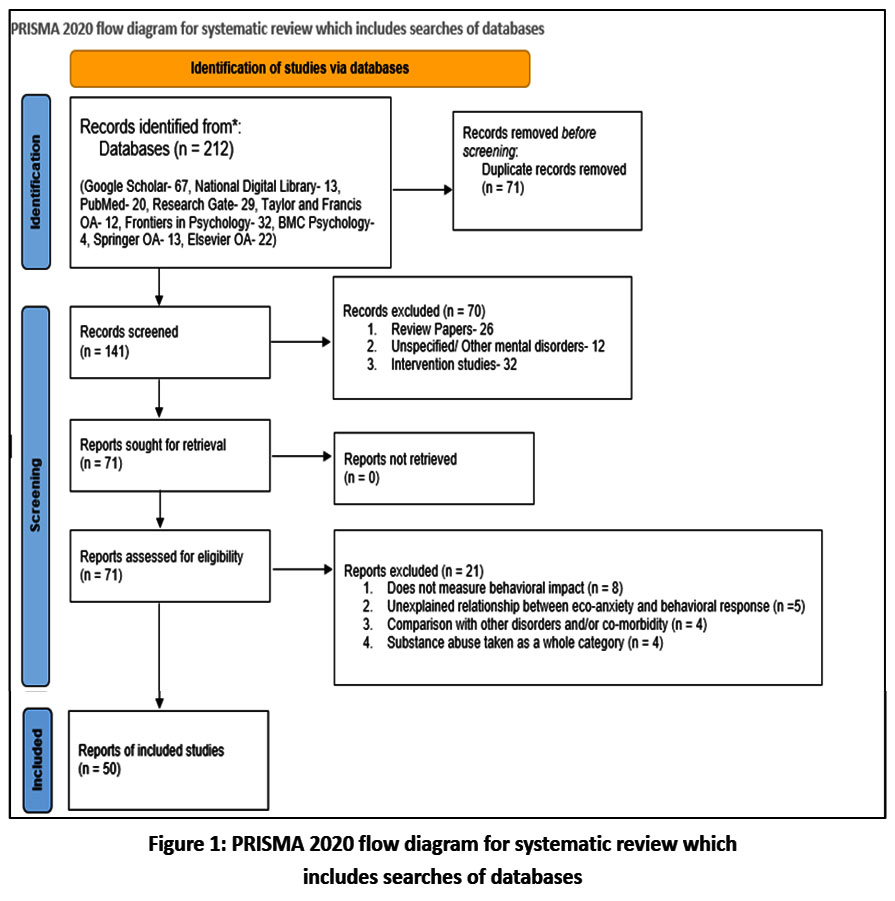 | Figure 1: PRISMA 2020 flow diagram for systematic review which includes searches of databases
|
Research designs and samples
The studies that were included in this scoping review investigated eco-anxiety and its behavioral manifestations using a range of study methodologies. Cross-sectional surveys, which offered snapshots of eco-anxiety and associated behaviors at particular times, were the most popular designs.12,16 These designs often relied on large, diverse samples to identify patterns and correlations between eco-anxiety and factors such as age, gender, and socio-cultural context. Numerous research used qualitative techniques, like as focus groups and interviews, to investigate the real-life experiences of people who struggle with eco-anxiety.17,18 These approaches allowed for a deeper understanding of how eco-anxiety manifests in various contexts and how individuals interpret and respond to it emotionally and behaviorally.
A lesser number of research employed mixed-methods techniques, which combined qualitative interviews with quantitative surveys to offer a thorough understanding of eco-anxiety. This approach proved particularly valuable in identifying not only the prevalence of eco-anxiety but also the underlying mechanisms and personal narratives associated with it.19,20 Experimental designs were less common but were used in a few studies to test the efficacy of interventions aimed at mitigating eco-anxiety. For example, interventions incorporating mindfulness and environmental education were examined for their impact on reducing eco-anxiety and promoting adaptive behaviors.21
The samples in these studies varied widely, ranging from small, localized groups to large, diverse populations across different countries. A notable focus was on younger demographics, particularly students and young adults, who were frequently identified as being disproportionately affected by eco-anxiety.15,17 Despite this, there remains a gap in research involving older populations, low-income communities, and individuals from non-Western contexts.
Tools used to measure
The measurement of eco-anxiety and its behavioral manifestations relied on a combination of standardized questionnaires and researcher-developed tools. These instruments aimed to capture various dimensions of eco-anxiety, its emotional correlates, and its impact on behavior. The Eco-Anxiety Scale (EAS) was one of the most commonly used tools. The EAS measures the intensity and frequency of eco-anxiety symptoms, including emotional distress and cognitive preoccupation with environmental issues.9 The Climate Anxiety Scale (CAS) is another tool that assesses specific fears and anxieties related to climate change, such as concerns about the future and feelings of helplessness. It has been validated in studies examining the prevalence of eco-anxiety across age groups.17
Also, the Environmental Distress Scale (EDS) was utilized by some studies as it focuses on emotional responses to ecological changes, including loss of biodiversity and extreme weather events. It is often used in studies linking eco-anxiety to mental health outcomes.22
Behavioral responses were measured using the Pro-Environmental Behavior Scale (PEBS), which measures actions taken to mitigate environmental impact, such as reducing energy consumption, recycling, and supporting environmental policies.16 Activism Engagement Index assesses the extent of individual involvement in climate activism, including participation in protests, community initiatives, and advocacy campaigns,17 and the Lifestyle Adjustment Inventory (LAI), as it captures changes in daily routines and consumption patterns motivated by eco-anxiety, such as adopting plant-based diets and reducing air travel.23 Some studies developed context-specific tools to explore the relationship between eco-anxiety and unique cultural or environmental factors. For example, qualitative interviews and thematic analysis were used to investigate eco-anxiety in Indigenous communities and their adaptive strategies.18 These tools, while valuable, highlight the need for standardization in measuring eco-anxiety and its behavioral effects to enable comparisons across studies and populations. Further development and validation of comprehensive instruments will be essential for advancing research in this field.
Findings
The themes that surfaced via data extraction utilizing traditional content analysis24 are included in this section. The procedure suggested by Saldaña (2021) was adhered to. To acquire a general idea of the behavioral implications and make preliminary notes on potential themes, both researchers first read each of the final included data. Second, each manuscript was examined separately by two researchers, who developed preliminary themes based on the characteristics of the initial notes. Third, themes were developed into broad sub-themes with many behavioral effects (based on shared findings). The sub-themes reflected the significance and content of the data. Ultimately, these sub-themes were refined to provide coherence across the various behavioral responses they included.25 The suggested sub-themes were refined with input from both researchers.
Theme 1: Adaptive Behavioral Response
Eco-anxiety causes adaptive behaviors that encourage resilience and pro-environmental behaviors. Studies highlight how individuals, particularly youth, channel their eco-anxiety into positive actions and coping strategies such as:
Activism and Engagement
Emotional responses to first-hand experiences with climate change, media portrayals of the problem, and a sense of powerlessness—particularly among youth—all inspire people to take action.26 Furthermore, elevated feelings of rage and frustration brought on by eco-anxiety can serve as a powerful catalyst for engaging in activist actions.27 Regaining agency and control over perceived environmental threats is the aim of the activist response, which is fuelled by eco-anxiety as a coping mechanism. Empirical studies that show a positive correlation between eco-anxiety and eco-activism provide more evidence for this relationship.
Eco-anxiety is a domain that usually motivates problem-solving actions, according to studies that indicate people feel some control over global environmental threats.28-31 Furthermore, eco-anxiety significantly predicts activist activity.19 This implies that people ought to act on their environmental concerns. Many factors influence how eco-anxiety evolves into activism. First, eco-anxiety acts as a mediator between attitudes toward climate change and the readiness to take action to safeguard the environment.20 Second, the elevated anxiety that comes from chronic eco-anxiety encourages people to engage in eco-activism and adopt a sustainable lifestyle.
Lastly, environmental education is also essential since scientific credibility and environmental awareness serve as a partial mediating component in the link indicated above. Furthermore, by using educational resources to alleviate eco-anxiety, people can transform powerlessness into proactive endeavors and gain a sense of agency.20,21 People who participate in this type of activity feel empowered, purposeful, and part of a community.17 When combined, these findings demonstrate how eco-anxiety, particularly in younger generations, motivates pro-environmental behavior.
Lifestyle Changes
People who experience eco-anxiety drastically change their way of living. The heightened awareness of climate change often results in altered behavior in those who experience eco-anxiety. Environment-friendly consumption practices, such as reducing plastic use, conserving water, reducing carbon footprints, etc., are commonly adopted by people.16,22 This change in consumption patterns is common. Additionally, as more people use carbon-reduction strategies, eco-anxiety has a significant influence on travel behaviors.32,33
Rumination and personal impact anxiety—the state in which people worry about their part in causing environmental degradation and often consider environmental issues—have a favorable correlation with pro-environmental behavior. Hogg et al.,30 claim that this relationship is often linear and that as these emotional and cognitive processes intensify, pro-environmental conduct increases proportionately. To maintain their mental health and well-being, many people opt to engage in mindfulness exercises, meditation, nature therapy, or environmental advocacy groups.
In addition to making deliberate travel and purchasing choices, persons who experience eco-anxiety also reduce their consumption of meat and dairy products and adopt more ecologically friendly eating habits.23,34 The necessity for supporting community structures to promote resilience is highlighted by the fact that, although eco-anxiety motivates many people to adopt more sustainable lives, it can also result in extreme stress and a sense of powerlessness.35
Community and Political Engagement
By increasing awareness of climate crises and encouraging a desire for collective action, eco-anxiety has a significant impact on community and political engagement.18 This is evident in movements led by individuals such as Greta Thunberg, and youth who experience eco-anxiety frequently become more involved in activism, including canvassing, voting behavior, and personal and group efficacy. Many young people turn their eco-anxiety into group action as they struggle with the overwhelming consequences of environmental degradation.36,37
Because of its negative impacts on mental health, eco-anxiety has an impact on political and community engagement, underscoring the need for multidisciplinary approaches and strategic communication in group learning.38 Despite causing psychological distress, eco-anxiety can occasionally result in greater resilience and well-being by facilitating introspection about one's role in the world and one's responsibility to mitigate the negative effects of ecological and climate crises, as well as by assisting people in aligning their behavior with their core values through political engagement, regardless of their political affiliation.36,39
Theme 2: Maladaptive Behavioral Response
Eco-anxiety leads to a range of negative behavioral impacts, many of which stem from feelings of powerlessness or overwhelm. Some of the key negative behavioral outcomes include:
Inaction
Some experts claim that people who suffer from eco-anxiety may get so overwhelmed that they neglect their environmental responsibilities. The American Psychological Association (2017) asserts that negative psychological responses to climate change hinder people's ability to respond to it constructively. Instead of working together to find a solution, they can start to think that the climate crisis is too big to handle, which could obstruct important conversations and actions. Because individuals feel somewhat powerless, they delay taking real action to combat climate change.18,40
This state of passivity is also known as eco-paralysis, which is sometimes mistaken for apathy. This passive state of behavioral stasis is characterized by depression, excessive worry, pessimism, and indifference. Research indicates that eco-anxiety can lead to either high self-efficacy activism or low self-efficacy eco-paralysis.28 Eco-anxiety also influences individual behaviors, including physical exercise (especially active transportation, which is known to have health benefits and the ability to cut greenhouse gas emissions), by paradoxically deterring people from engaging in physical activity. This psychological response might have an impact on ecological sustainability projects and overall well-being by decreasing the use of active transportation because of sentiments of powerlessness and anxiety about environmental concerns.41
Self-destructive behaviors
Self-destructive conduct is a sort of cognitive failure caused by the desire to die, which results in self-destruction. Eco-anxiety promotes self-destructive behaviors since substance usage is closely linked to feelings of worry, hopelessness, and loneliness. According to research, crop failures are increasing in frequency as a result of climate change, which affects those who depend on agriculture as their main source of income, especially farmers. This leads to a sense of loss and powerlessness and raises the risk of substance misuse, despair, suicide, and self-destructive behaviors.42
Dangerous substance use habits have been established in numerous studies as a coping technique for harsh weather and eco-anxiety.43 Global temperatures have increased by 1.1°C since preindustrial times, making natural disasters more frequent and severe.1
This is also upending important aspects of life, such as work, social networks, healthcare, and education. These disruptions, which may promote risky substance use or make it easier for people to relapse into addiction, disproportionately impact underprivileged areas. This could happen in several ways, including stress from unstable social and environmental systems, a rise in mental and physical health issues, behavioral changes, and fear of future climate impacts.
When combined, these factors may raise a person's risk of using drugs as a coping strategy.4,5,44,45 Each of these pathways may impact substance use differently. For example, the stress of losing a job or a home due to natural disasters may make people more likely to take drugs. Mental health issues like depression or anxiety, which can worsen due to climate change, also raise the risk. Additionally, climate change-related physical health problems, such as extreme heat, can worsen eco-anxiety, raise stress levels, and disturb established routines, which makes it easier to engage in risky behavior. Despite their connections, each of these routes may have a distinct impact on various individuals; therefore, it's critical to investigate them independently to better understand and manage the risks.46
Fear of the future
Young adults are naturally more prone to eco-anxiety given the uncertain future they face, since they see those with the ability to make changes to be unsupportive and misinformed.9,17,47 These eco-anxious people take climate change into account when choosing a place to live because rising worries about climate-related calamities, including floods, wildfires, or extreme weather, frequently motivate people to rethink where they already reside.
Another area where eco-anxiety is noticeable is in financial decisions. Environmentally conscious people could focus on adopting or promoting long-term, sustainable practices.50 This entails supporting systemic change by supporting green businesses or political campaigns, as well as making individual decisions like buying eco-friendly products, sustainable housing, or renewable energy.48,49
Career choices are also impacted since individuals who suffer from eco-anxiety frequently change their job routes to ones that support ecological conservation or are more environmentally sustainable.17 Concerns about resource scarcity, overcrowding, and the planet's future can make individuals reevaluate the morality of introducing new life in a world where the environment is deteriorating. Many people who suffer from eco-anxiety may decide to postpone or forego having children because, in the latter years of the 2010s, an increasing number of people stated that eco-anxiety was a major factor in their reluctance to have children.9,12,17
These findings demonstrate that eco-anxiety is not simply an in-the-moment response to current events, but is influencing young people's decision-making in important ways.
Table 1: Behavioral Responses Categorized into Themes and Sub-Themes
Theme | Sub-Theme | Behavioral Examples |
Adaptive Behavioral Responses | Activism and Engagement | Participation in protests, advocacy, and reclaiming agency17,26 |
Lifestyle Changes | Reducing plastic use, adopting plant-based diets, and mindful consumption16,23 | |
Community and Political Engagement | Involvement in local initiatives, collective climate action18,36 | |
Maladaptive Behavioral Responses | Inaction | Eco-paralysis, avoidance of climate issues28,40 |
Self-Destructive Behaviors | Substance abuse, harmful coping strategies42,43 | |
Fear of the Future | Reluctance to have children, career shifts, and reconsidering residence 12 |
Table 2: Sample Groups, Tools, and Studies (Detailed)
Sample Group | Tools Used |
Young Adults and Students | Eco-Anxiety Scale (EAS), Climate Anxiety Scale (CAS)15,17 |
General Population | Environmental Distress Scale (EDS), Pro-Environmental Behavior Scale (PEBS)16,20,22 |
Indigenous Communities | Qualitative Interviews, Activism Engagement Index17,18,21 |
Vulnerable Populations | Lifestyle Adjustment Inventory (LAI), Thematic Analysis5,42,43 |
Discussion and future directions
The dual nature of eco-anxiety and its significant influence on people's actions, choices, and long-term planning are highlighted in this paper. On the one hand, activism and a sense of belonging and purpose are fuelled by the emotional intensity of eco-anxiety, especially feelings of anger and powerlessness. As a result, eco-anxiety is a powerful motivation for activism and engagement, particularly among young people. It can also result in adaptive reactions, where people use their worry to improve their lifestyles and take important pro-environmental actions. Through pro-environmental actions and environmental campaigning, people try to restore agency and control.
There is also a considerable correlation between eco-anxiety and changes in lifestyle. According to the research, those who suffer from eco-anxiety change their travel habits, cut back on their carbon footprint, and switch to more environmentally friendly eating habits. These lifestyle adjustments are an effort to balance environmental consciousness with personal anxiety. The impact of eco-anxiety is further demonstrated by community and political engagement, as evidenced by youth movements, collective climate action, and heightened political participation spurred by environmental concerns.
On the other hand, constructive climate action may be hampered by eco-anxiety and the maladaptive reactions it generates, which include apathy, self-destructive activities, and overpowering terror. Meaningful participation in environmental concerns is hindered by eco-paralysis, a form of behavioral stasis driven by extreme worry and a sense of hopelessness. Especially in vulnerable groups, the psychological toll of eco-anxiety can show up as self-destructive behaviors like substance misuse, which are made worse by emotions of helplessness and environmental loss. Major life decisions such as where to live, financial investments, career paths, and family planning are also influenced by fear of the future, including worries about overpopulation, environmental degradation, and resource shortages. These results imply that although eco-anxiety may serve as an adaptive reaction for certain people, it may also become incapacitating, particularly when people believe that larger social systems are not supporting them.
People may have detrimental psychological effects in the absence of proper mental health interventions, highlighting the necessity of all-encompassing support networks to mitigate the psychological effects of eco-anxiety. Future studies should concentrate on more longitudinal studies that examine the long-term impacts of eco-anxiety on activism, mental health, and lifestyle decisions, given the intricate link between eco-anxiety and behavior. Such research would shed more light on the development of eco-anxiety and its long-term effects on both individual and group behavior.
Eco-anxiety can spur constructive change, but it can also result in crippling worry. Coping mechanisms that lessen the detrimental consequences of eco-anxiety should be the subject of future research. Pathways to resilience and long-term pro-environmental behavior can be shown by examining the roles of mental health interventions, environmental education, and community participation. Additionally, studies should look at the ways that eco-anxiety appears in various social and cultural contexts. A more detailed understanding of how various populations perceive and react to psychological suffering due to climate change can be obtained by comprehending how social, political, and environmental aspects shape eco-anxiety.
Targeted interventions that support mental health and well-being should be used to alleviate the psychological effects of eco-anxiety. Future studies should create and evaluate interventions that include mindfulness, cognitive behavioral therapy, and nature-based therapies to manage eco-anxiety and lessen feelings of powerlessness. Since younger generations are disproportionately affected by eco-anxiety, especially when it comes to making decisions, more research should examine how young people view climate concerns and incorporate climate action into their personal and professional lives. Programs that include young people in environmental advocacy and solution-based activism may play a key role in helping them develop a feeling of agency.
Limitations
Although the review synthesizes emerging evidence linking eco-anxiety to behavioral outcomes, the methodological quality of included studies warrants caution. Many studies relied on cross-sectional designs, self-report measures, and convenience samples, limiting causal inference and generalizability. These limitations may inflate associations between eco-anxiety and pro-environmental behavior due to shared method variance and social desirability effects. Therefore, conclusions regarding behavioral activation versus eco-paralysis should be interpreted as provisional rather than definitive.
Addressing the limitations individually, first, there has been little empirical research looking at the prevalence, psychological underpinnings, and behavioral ramifications of eco-anxiety, making the field still relatively young. The lack of study impedes the creation of a thorough understanding of eco-anxiety in a variety of settings and demographics. Second, there are discrepancies in the definition and assessment of eco-anxiety because the concept is not yet defined in the literature.
It is difficult to distinguish the term's distinctive features and behavioral effects because it is frequently used interchangeably with comparable concepts like climate grief or solastalgia. Third, although eco-anxiety is becoming more widely recognized, less study has been done to examine how it affects particular behavioral consequences. Few research examine the relationship between eco-anxiety and pro-environmental activities, while some concentrate solely on the emotional or psychological aspects of eco-anxiety, leaving behavioral aspects understudied.
Fourth and finally, there are very few intervention studies that focus on eco-anxiety, which makes it difficult to evaluate practical methods for addressing its behavioral and psychological effects. Additionally, the majority of current research focuses on wealthy Western nations, ignoring the experiences of people in low-income or extremely vulnerable areas that are disproportionately impacted by climate change. This lack of a global perspective limits the findings' generalizability and fails to capture the variety of eco-anxiety experiences around the globe.
To improve our knowledge of eco-anxiety and its behavioral effects, more comprehensive, internationally representative, and intervention-focused research is required. Filling in these gaps will be essential to creating focused plans to reduce eco-anxiety and encourage positive behavioral reactions.
Conclusion
The considerable influence of eco-anxiety on human behavior is highlighted in the current systematic scoping review. As CC increases, eco-anxiety is rising and becoming more common, particularly among younger generations who are worried about the future of the environment. It is a potent psychological reaction to environmental crises, and building resilience, encouraging pro-environmental behavior, and creating successful mental health interventions all depend on knowing how eco-anxiety influences long-term decisions and lifestyle modifications.
People's knowledge of ecological dangers and their repercussions for present and future generations is reflected in eco-anxiety, which is closely linked to the continuing climate crisis. According to our literature search, eco-anxiety can motivate adaptive actions that empower people and give them a sense of purpose and agency, like environmental activism, sustainable lifestyle modifications, and community involvement. But the review also emphasizes how common maladaptive behaviors are, such as eco-paralysis, self-destructive tendencies, and passivity, and how these behaviors are frequently fuelled by feelings of powerlessness and helplessness.
The necessity for programs that address the psychological effects of eco-anxiety while encouraging healthy coping strategies is underscored by these maladaptive reactions. Furthermore, as evidenced by its widespread influence on societal and demographic patterns, eco-anxiety affects important life decisions like financial investments, career choices, and family planning.
Many gaps in the existing literature are noted by the review. Research findings have been inconsistent in part because eco-anxiety and its quantification lack a defined definition. Furthermore, the majority of research has concentrated on Western people, ignoring a variety of cultural and socioeconomic factors that could influence distinct eco-anxiety experiences.
Furthermore, our knowledge of the long-term psychological and behavioral repercussions of eco-anxiety is limited by the lack of longitudinal and intervention-based studies.
In order to fill these gaps, future studies should investigate eco-anxiety across a variety of demographics and look at mediating elements, including access to sustainable resources, social support systems, and cultural norms. To turn eco-anxiety into a driving force for significant climate action while preserving mental health, it will be essential to develop and implement interventions, such as mindfulness-based therapy and environmental education.
In conclusion, eco-anxiety is a prime example of the complex interrelationship between human psychology and environmental catastrophes. We can use eco-anxiety as a catalyst for change while reducing its negative effects by encouraging resilience, supporting mental health, and creating welcoming community support networks. Achieving sustainable development and guaranteeing the welfare of people and communities everywhere will require including mental health concerns in climate action strategies.
Acknowledgment
The authors are sincerely grateful to all the participants from Uttarakhand who generously shared their lived experiences and reflections. We also thank the Department of Social and Behavioral Sciences at Manav Rachna International Institute of Research Studies for the academic mentorship, critical insights, and guidance throughout the research process. Their intellectual support and encouragement significantly strengthened the conceptual and methodological rigor of this work.
Funding Sources
The author(s) received no financial support for the research, authorship, and/or publication of this article.
Conflict of Interest
The authors do not have any conflict of interest.
Data Availability Statement
The datasets generated and/or analyzed during the current review are available from the corresponding author upon reasonable request.
Ethics Statement
This research did not involve human participants, animal subjects, or any material that requires ethical approval.
Informed Consent Statement
This study did not involve human participants, and therefore, informed consent was not required.
Permission to Reproduce Material from Other Sources
Not Applicable
Author Contributions
Mr. Abhinav Atri : Conceptualization,Writing Original Draft, Data collection, Analysis,
Supriya Srivastava: Supervision, Editing, Review
References
- Intergovernmental Panel on Climate Change. Climate change 2022: impacts, adaptation and vulnerability. Cambridge University Press; 2022.
CrossRef - Léger-Goodes T, Malboeuf-Hurtubise C, Mastine T, Généreux M, Paradis PO, Camden C. Eco-anxiety in children: a scoping review of the mental health impacts of the awareness of climate change. Front Psychol. 2022;13:872544. doi:10.3389/fpsyg.2022.872544
CrossRef - Hacker K, Houry D. Social needs and social determinants: the role of the Centers for Disease Control and Prevention and public health. Public Health Rep. 2022. doi:10.1177/00333549221120244
CrossRef - Intergovernmental Panel on Climate Change. Climate change 2021: the physical science basis. Cambridge University Press; 2021.
- Romanello M, McGushin A, Napoli CD, et al. The 2021 report of the Lancet Countdown on health and climate change: code red for a healthy future. Lancet. 2021;398(10311):1619-1662. doi:10.1016/S0140-6736(21)01787-6
CrossRef - Berry HL, Waite TD, Dear K, Capon AG, Murray V. The case for systems thinking about climate change and mental health. Nat Clim Change. 2018;8(4):282-290. doi:10.1038/s41558-018-0102-4
CrossRef - Arksey H, O’Malley L. Scoping studies: towards a methodological framework. Int J Soc Res Methodol. 2005;8(1):19-32. doi:10.1080/1364557032000119616
CrossRef - Agarwal D, Hanafi NS, Chippagiri S, et al. Systematic scoping review protocol of methodologies of chronic respiratory disease surveys in low/middle-income countries. npj Prim Care Respir Med. 2019;29(1):17. doi:10.1038/s41533-019-0129-7
CrossRef - Clayton S, Karazsia BT. Development and validation of a measure of climate change anxiety. J Environ Psychol. 2020;69:101434. doi:10.1016/j.jenvp.2020.101434
CrossRef - Brophy H, Olson J, Paul P. Eco-anxiety in youth: an integrative literature review. Int J Ment Health Nurs. 2023;32:633-661.
CrossRef - Crandon TJ, Scott JG, Charlson FJ, et al. A social-ecological perspective on climate anxiety in children and adolescents. Nat Clim Change. 2022;12:123-131.
CrossRef - Hickman C. We need to (find a way to) talk about… eco-anxiety. J Soc Work Pract. 2020;34(4):411-424.
CrossRef - Wray B. Generation dread: finding purpose in an age of climate crisis. Penguin Random House; 2022.
- Levac D, Colquhoun H, O'Brien KK. Scoping studies: advancing the methodology. Implement Sci. 2010;5:69. Published 2010 Sep 20. doi:10.1186/1748-5908-5-69
CrossRef - Pihkala P. Eco-anxiety and environmental education. Sustainability. 2020;12(23):10149. doi:10.3390/su122310149
CrossRef - Bouman T, Verschoor M, Albers CJ, et al. When worry about climate change leads to climate action: how values, worry and personal responsibility relate to various climate actions. Glob Environ Change. 2020;62:102061. doi:10.1016/j.gloenvcha.2020.102061
CrossRef - Hickman C. Eco-anxiety in children and young people—A rational response, irreconcilable despair, or both? Psychoanal Study Child. 2024;77(1):356-368. doi:10.1080/00797308.2023.2287381
CrossRef - Davidson JPL. Two cheers for collapse? On the uses and abuses of the societal collapse thesis for imagining Anthropocene futures. Environ Polit. 2023;32(6):969-987. doi:10.1080/09644016.2022.2164238
CrossRef - Nishtha Jain and Prashasti Jain 2022 IOP Conf. Ser.: Earth Environ. Sci. 1084 012007
CrossRef - Vecina ML, Alonso-Ferres M, López-García L, Díaz-Silveira C. Eco-Anxiety and Trust in Science in Spain: Two Paths to Connect Climate Change Perceptions and General Willingness for Environmental Behavior. Sustainability. 2024; 16(8):3187. https://doi.org/10.3390/su16083187
CrossRef - Pavani JB, Nicolas L, Bonetto E. Eco-anxiety motivates pro-environmental behaviors: a two-wave longitudinal study. Motiv Emot. 2023;47: doi:10.1007/s11031-023-10038-x
CrossRef - Buzzell L, Chalquist C. From eco-anxiety to eco-resilience: toward a psychology of care. In: Vakoch DA, Mickey S, eds. Eco-Anxiety and Pandemic Distress: Psychological Perspectives on Resilience and Interconnectedness. New York, NY: Oxford University Press; 2023. doi:10.1093/oso/9780197622674.003.0003
CrossRef - Kabasakal-Cetin A. Association between eco-anxiety, sustainable eating and consumption behaviors and the EAT-Lancet diet score among university students. Food Qual Prefer. 2023;111:104972. doi:10.1016/j.foodqual.2023.104972
CrossRef - Hsieh HF, Shannon SE. Three approaches to qualitative content analysis. Qual Health Res. 2005;15(9):1277-1288. doi:10.1177/1049732305276687
CrossRef - Saldaña J. The coding manual for qualitative researchers. 4th ed. SAGE; 2021.
- Rajamani SK, Iyer R. Waste electrical and electronic equipment disposal problem in India, routes of disposal, toxicology, and impact on human health: a narrative review. MMJ. 2024;7:34-42. doi:10.15713/ins.mmj.93
- Uchendu JO. Eco-anxiety and its divergent power holds: a youth climate activist’s perspective. S Afr J Psychol. 2022. doi:10.1177/00812463221130586
CrossRef - Innocenti M, Santarelli G, Lombardi GS, et al. How can climate change anxiety induce both pro-environmental behaviors and eco-paralysis? The mediating role of general self-efficacy. Int J Environ Res Public Health. 2023;20(4):3085. doi:10.3390/ijerph20043085
CrossRef - Schwartz SEO, Benoit L, Clayton S, Parnes MF, Swenson L, Lowe SR. Climate change anxiety and mental health: Environmental activism as buffer. Curr Psychol. Published online February 28, 2022. doi:10.1007/s12144-022-02735-6
CrossRef - Stanley SK, Hogg TL, Leviston Z, Walker I. From anger to action: differential impacts of eco-anxiety, eco-depression, and eco-anger on climate action and wellbeing. J Clim Change Health. 2021;1:100003. doi:10.1016/j.joclim.2021.100003
CrossRef - Verplanken B, Marks E, Dobromir AI. On the nature of eco-anxiety: how constructive or unconstructive is habitual worry about global warming? J Environ Psychol. 2020;72:101528. doi:10.1016/j.jenvp.2020.101528
CrossRef - Enlund J, Andersson D, Carlsson F. Individual carbon footprint reduction: evidence from pro-environmental users of a carbon calculator. Environ Resour Econ. 2023;86:433-467. doi:10.1007/s10640-023-00800-7
CrossRef - Leal Filho W, et al. An overview of the engagement of higher education institutions in the implementation of the UN Sustainable Development Goals. J Clean Prod. 2023;386:135694. doi:10.1016/j.jclepro.2022.135694
CrossRef - Sawicki CM, Ramesh G, Bui L, et al. Planetary health diet and cardiovascular disease: results from three large prospective cohort studies in the USA. Lancet Planet Health. 2024;8(9):e666-e674. doi:10.1016/S2542-5196(24)00170-0
CrossRef - Yampolskiy, Roman. (2023). Unmonitorability of Artificial Intelligence.
- Anneser E, Levine P, Lane KJ, Corlin L. Climate stress and anxiety, environmental context, and civic engagement: a nationally representative study. J Environ Psychol. 2024;93:102220. doi:10.1016/j.jenvp.2023.102220
CrossRef - Kratz S, McEwan K. From roots to action: how adolescent nature exposure and adult eco-anxiety foster pro-environmental behavior. Curr Psychol. 2025;44:15270-15279. doi:10.1007/s12144-025-08216-w
CrossRef - Wang H, Safer DL, Cosentino M, et al. Coping with eco-anxiety: an interdisciplinary perspective for collective learning and strategic communication. J Clim Change Health. 2022;9:100211. doi:10.1016/j.joclim.2023.100211
CrossRef - Lutz PK, Zelenski JM, Newman DB. Eco-anxiety in daily life: relationships with well-being and pro-environmental behavior. Curr Res Ecol Soc Psychol. 2023;4:100110. doi:10.1016/j.cresp.2023.100110
CrossRef - Ágoston C, Csaba B, Nagy B, et al. Identifying types of eco-anxiety, eco-guilt, eco-grief, and eco-coping in a climate-sensitive population: a qualitative study. Int J Environ Res Public Health. 2022;19(4):2461. doi:10.3390/ijerph19042461
CrossRef - Derigny T, Schnitzler C, Vors O, Huchez A, Gerard T, Mallet S, Gandrieau J, Potdevin F. “The teacher could correct me without being there”: adapting distance education approaches to promote physical activity during lockdown. Eur Phys Educ Rev. 2023. doi:10.1177/1356336X231160404
CrossRef - Pandey DN. Beyond Vanishing Woods: Participatory Survival Options for Wildlife, Forests, and People. 2nd ed. Himanshu Publications; 1996.
- Vergunst F, Berry HL. Climate Change and Children's Mental Health: A Developmental Perspective. Clin Psychol Sci. 2022;10(4):767-785. doi:10.1177/21677026211040787
CrossRef - Berrang-Ford L, Sietsma AJ, Callaghan M, et al. Systematic mapping of global research on climate and health: a machine learning review. Lancet Planet Health. 2021;5:e514-e524. doi:10.1016/S2542-5196(21)00179-0
CrossRef - World Health Organization. Climate change and health. Published 2021. Accessed February 26, 2026. https://www.who.int/news-room/fact-sheets/detail/climate-change-and-health
- Martin L, White MP, Hunt A, Richardson M, Pahl S, Burt J. Nature contact, nature connectedness and associations with health, wellbeing and pro-environmental behaviours. J Environ Psychol. 2020;68:101389. doi:10.1016/j.jenvp.2020.101389
CrossRef - Ma T, Moore J, Cleary A. Climate change impacts on the mental health and wellbeing of young people: a scoping review of risk and protective factors. Soc Sci Med. 2022;301:114888. doi:10.1016/j.socscimed.2022.114888
CrossRef - Anderson A, Robinson DT. Climate fears and the demand for green investment. Swedish House of Finance Research Paper No. 19-14. Published November 20, 2019. doi:10.2139/ssrn.3490730
CrossRef - Fontes E, Moreira A, Carlos V. The influence of ecological concern on green purchase behavior. Manag Mark Chall Knowl Soc. 2021;16:246-267. doi:10.2478/mmcks-2021-0015.
CrossRef - Nairn K. Learning from young people engaged in climate activism: the potential of collectivizing despair and hope. Young. 2019;27:435-450.
CrossRef