
Design and Cost Analysis of a Waste Management Plant in Sivagangai District, Tamil Nadu, India
Perumal Raj Manikandan1
*
 , Ramaiah Prakash1
and Sundaresan Srividhya2
, Ramaiah Prakash1
and Sundaresan Srividhya2
1
Department of Civil Engineering,
Alagappa Chettiar Government College of Engineering and Technology,
Karaikudi,
Tamil Nadu
India
2
Kangeyam Institute of Technology,
Kangeyam,
Tirupur
India
http://dx.doi.org/10.12944/CWE.21.1.27
Copy the following to cite this article:
Manikandan P. J, Prakash R, Srividhya S. Design and Cost Analysis of a Waste Management Plant in Sivagangai District, Tamil Nadu, India. Curr World Environ 2026;21(1). DOI:http://dx.doi.org/10.12944/CWE.21.1.27
Copy the following to cite this URL:
Manikandan P. J, Prakash R, Srividhya S. Design and Cost Analysis of a Waste Management Plant in Sivagangai District, Tamil Nadu, India. Curr World Environ 2026;21(1).
Download article (pdf)
Citation Manager
Publish History

Introduction
The rapid pace of urbanization and industrialization has significantly increased municipal solid waste (MSW) generation across the world, creating major environmental and management challenges. Developing countries, particularly India, are experiencing substantial growth in waste production due to population expansion, urban migration, and changing consumption patterns.1,2 According to the Central Pollution Control Board (CPCB), India generates more than 1.5 lakh metric tons of municipal solid waste every day, and a considerable portion of this waste remains untreated or improperly disposed of, resulting in serious environmental and public health concerns.3,4
Improper waste disposal practices such as open dumping and uncontrolled landfilling are still prevalent in many parts of the country. These practices contribute to soil and groundwater contamination and produce harmful greenhouse gases such as methane during the decomposition of organic waste.10 Methane emissions from landfill sites are considered a major contributor to global climate change and environmental degradation.11 Therefore, improving waste treatment infrastructure and implementing sustainable waste management strategies have become essential priorities for governments and environmental agencies worldwide.5
Tamil Nadu is one of the major waste-generating states in India, producing nearly 13,000 metric tons of municipal solid waste per day. However, several districts continue to face challenges due to inadequate waste treatment infrastructure, limited recycling facilities, and inefficient waste collection systems.5,20 Sivagangai District, located in southern Tamil Nadu, is gradually experiencing urban growth and increasing waste generation. The district currently produces approximately 150 metric tons of solid waste per day, with projections indicating a continuous rise due to population growth and urban expansion.19
Globally, the volume of municipal solid waste is expected to increase significantly in the coming decades. According to the World Bank’s global waste management report, waste generation could increase by nearly 70% by 2050 if sustainable waste management strategies are not implemented effectively.12 The increasing waste burden highlights the importance of adopting integrated solid waste management systems that combine waste segregation, recycling, composting, and environmentally safe landfill disposal.7,14
Integrated waste management frameworks are widely recognized as effective approaches for reducing environmental impacts while improving resource recovery from waste streams.8 These systems typically incorporate facilities such as Material Recovery Facilities (MRFs), composting units, anaerobic digestion systems, and engineered landfills with leachate treatment and methane capture technologies.16,17 Such systems help reduce landfill dependency while promoting circular economy practices and sustainable resource utilization.13
Several successful waste management models have been implemented in different regions of India. For instance, Pune has developed an integrated waste management system emphasizing recycling, composting, and decentralized waste processing.8 Similarly, the Coimbatore biogas plant effectively converts organic waste into renewable energy through anaerobic digestion technology.16 These initiatives demonstrate the potential benefits of combining engineering design, environmental management practices, and policy support in waste management systems.
In addition to national initiatives, international organizations and environmental agencies have emphasized the importance of modern waste treatment technologies and sustainable infrastructure for addressing global waste challenges.15,22 Countries such as Sweden and Germany have achieved recycling rates exceeding 50% by implementing advanced waste segregation and recovery systems.6 Lessons from these global best practices can be adapted to developing regions to improve waste management efficiency and environmental sustainability.18
Considering the increasing waste generation and environmental concerns in Sivagangai District, there is a pressing need for a scientifically designed waste management facility that integrates modern waste processing technologies. The development of a sustainable waste management plant can significantly reduce pollution, enhance resource recovery, and support environmental protection initiatives in the region.21 Furthermore, implementing integrated waste management infrastructure can contribute to climate change mitigation by reducing methane emissions and promoting renewable energy generation from organic waste streams.23
Therefore, the present study aims to propose the design and cost analysis of an integrated waste management plant in Sivagangai District, Tamil Nadu. The proposed facility incorporates key components such as a Material Recovery Facility (MRF), composting units, leachate treatment systems, and sanitary landfill design in accordance with regulatory guidelines. The study provides a practical engineering framework that can be replicated in other semi-urban districts to improve municipal solid waste management and environmental sustainability.
Objective
To design a scalable, sustainable waste management plant based on proven models tailored to the specific needs of the Sivagangai District. The plant will focus on waste segregation, recycling, and composting while ensuring regulatory compliance.
Research Gap
Although several cities in India such as Pune and Coimbatore have implemented integrated waste management systems, there is limited literature on district-level scalable design models tailored to semi-urban regions like Sivagangai. Most studies focus either on policy evaluation or isolated treatment technologies rather than an integrated engineering and cost feasibility model. This study addresses this gap by proposing a comprehensive design supported by phased construction planning and financial estimation.
Materials and Methods
Study Area
Sivagangai District, in the southern part of Tamil Nadu, has an area of 4,189 square kilometers. The district's climate is generally tropical, with moderate to high temperatures and seasonal rainfall, which can have an impact on waste management facilities' operations. The district's metropolitan centers, such as Sivagangai, Karaikudi, and Devakottai, generate the majority of municipal solid garbage, while rural areas contribute agricultural and organic waste. According to contemporary estimates, the district creates about 150 metric tons of solid trash each day, with projections showing a constant increase due to population development and urbanization. The current trash management procedures include open dumping and inadequate recycling activities, necessitating the establishment of an organized waste management facility. Figure 1 illustrates the geographical location of Sivagangai District in Tamil Nadu, highlighting its proximity to major waste-generating urban centers such as Karaikudi and Devakottai. The map supports site selection planning and transportation logistics analysis for the proposed facility.
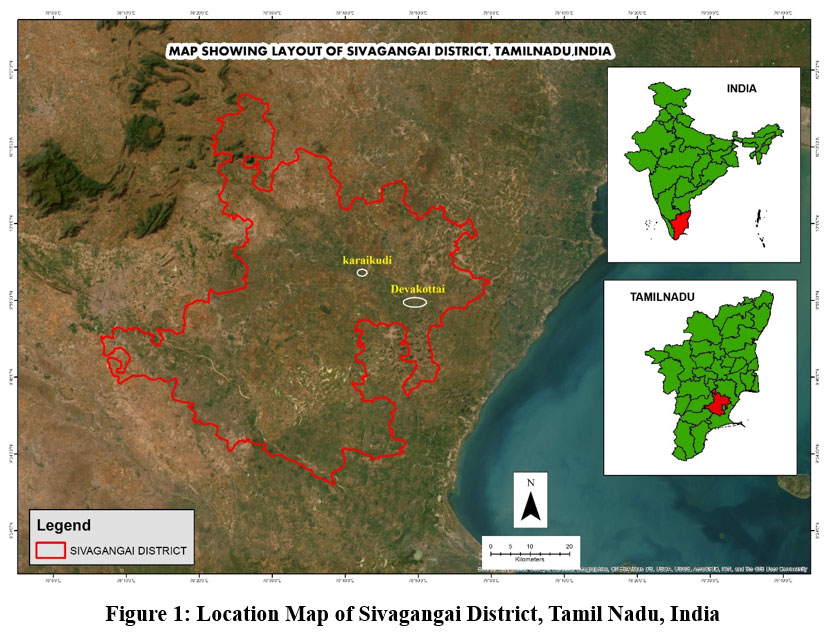 | Figure 1: Location Map of Sivagangai District, Tamil Nadu, India.
|
Waste Management Plant Layout
Waste Management Plant Design Overview with Consideration of Drawings
The waste management plant design incorporates proven elements from municipal solid waste facilities in cities such as Pune and Chennai, with detailed drawings referenced to ensure an efficient and well-organized layout. Key components include the Waste Reception and Sorting Area, as illustrated in the Schematic Plan of the Transfer Station (Fig. 2) and the Section of the Ramp of the Transfer Station (Fig. 3).The design emphasizes an efficient flow of waste trucks, ensuring smooth traffic movement and effective initial segregation of waste at the point of entry.The layout incorporates two wide gates (8m each) to facilitate the entry and exit of waste trucks, enhancing operational efficiency by minimizing congestion during peak hours. The perimeter is enclosed by a secure compound wall, which guarantees limited access and upholds safety regulations for facility operations. A three-by-three-meter security cabin at the entrance offers room for keeping an eye on and managing vehicle admission as well as upholding security procedures.
Accurate measurement of arriving garbage loads is made possible by a weighbridge (6 m × 9 m) at the entry. The weighing control system and documentation staff are housed in an adjacent cabin (3 m x 3 m). A well-equipped restroom cabin (3 m x 9 m) and a staff room (5 m x 10 m) are located close to the operational area to serve employees who work long hours. These areas allow employees to rest, store personal things, and perform administrative duties associated with waste management operations.
The reception area’s concrete pavements offer a long-lasting, easily maintained surface that facilitates the movement of large vehicles and equipment. A 10-meter-wide green belt encircles the space, acting as a buffer zone to lower noise and air pollution while improving the facility’s aesthetic appeal and environmental sustainability. In accordance with best standards in ergonomic and operational design, trucks drop waste onto a specially made platform, allowing for speedy offloading and preliminary sorting. A ramp provides easy access to raised portions of the sorting area. Near the entrance, the 9 m x 10 m administrative office controls facility upkeep, plans waste processing schedules, and runs daily operations. At order to expedite the sorting process prior to additional processing at the Material Recovery Facility (MRF), waste materials are collected and temporarily stored in strategically placed hoppers. A sizable workshop space (10 m x 35 m) is also accessible for the maintenance and repair of facility machinery, such as conveyors, sorting belts, and other pieces of equipment essential to plant operations. Drawing inspiration from successful designs such as the Pune Municipal Solid Waste Management Facility, the reception and sorting area is carefully planned to guarantee the smooth integration of operational flow, safety, and environmental management.
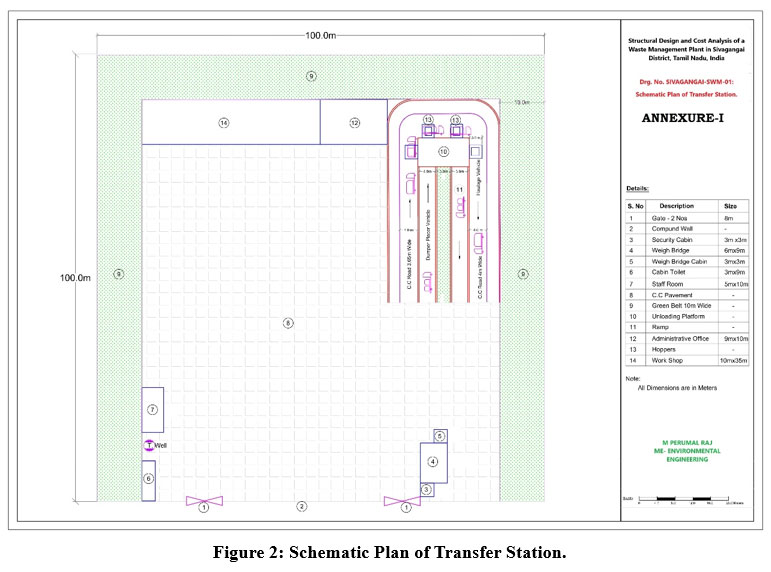 | Figure 2: Schematic Plan of Transfer Station.
|
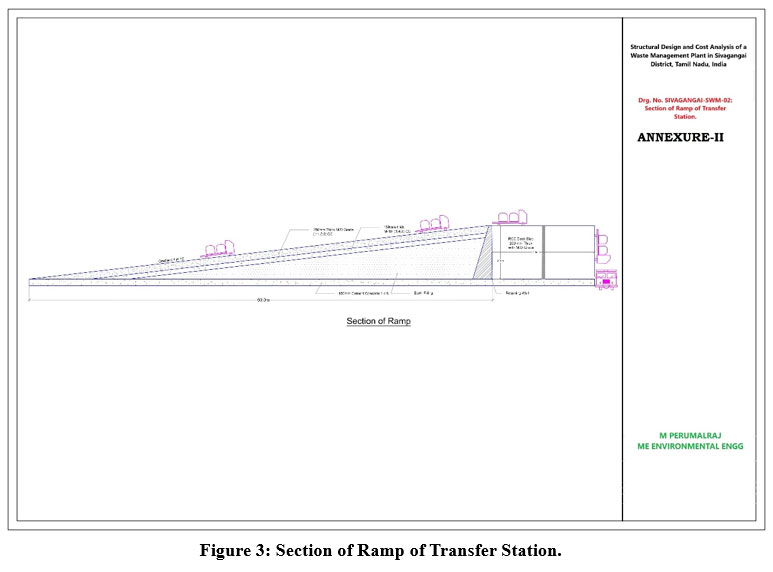 | Figure 3: Section of Ramp of Transfer Station.
|
Material Recovery Facility (MRF)
Figure 4 illustrates the Material Recovery Facility (MRF), depicting the machinery and equipment installed within the transfer station. This drawing serves as the relevant reference for the MRF layout. Inspired by the Okhla Waste-to-Energy Plant, the facility is designed to streamline the sorting and processing of recyclable materials. To maximize resource recovery from mixed waste streams, the MRF incorporates advanced sorting technologies, including sorting belts and conveyor systems.
The static compactor, one of the MRF’s essential parts, compresses waste materials to reduce their volume for effective handling and transportation. Large volumes of garbage are efficiently managed by this technology, increasing the overall effectiveness of the facility. Furthermore, sorted materials are momentarily held in the storage hopper prior to transportation or additional processing. Its thoughtful positioning inside the MRF facilitates the constant movement of materials along the sorting line, avoiding obstructions and guaranteeing efficient operations.
By making it simple to load and unload compacted waste into transport containers, the hook loader system improves operational flexibility and makes it possible to quickly switch between various waste streams or recovered material kinds. Within the MRF, a number of bins are positioned to gather sorted items, including paper, metals, plastics, and organic waste. Before recyclables are transported to the proper processing facilities, these containers allow for the organized storage of recyclables.
The design of the MRF places a strong emphasis on increasing material recovery efficiency, decreasing the quantity of waste sent to landfills, and encouraging the recycling of precious resources. As demonstrated by the Okhla Waste-to-Energy Plant, this strategy is in line with contemporary waste management techniques.
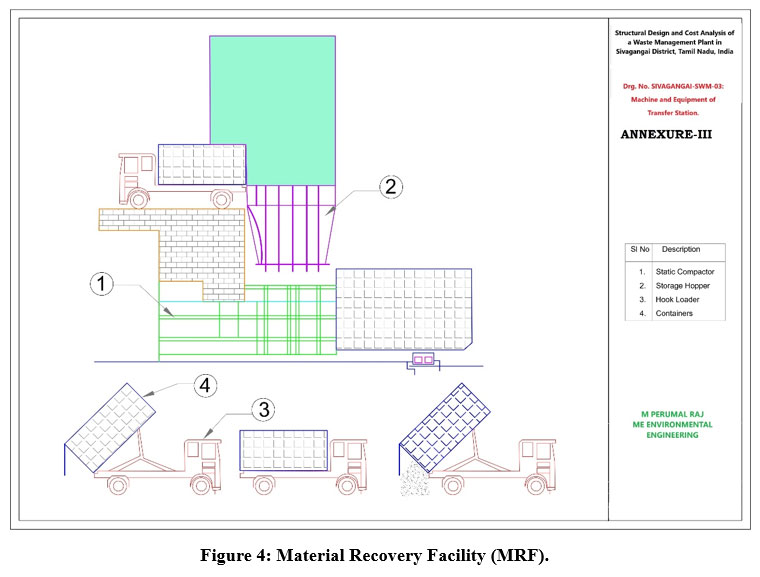 | Figure 4: Material Recovery Facility (MRF).
|
Composting Section
The relevant drawing for the composting section is Fig. 5, which illustrates the compost plant layout. This section is based on successful implementations, such as the Coimbatore Biogas Plant, which efficiently processes organic waste by integrating windrow systems and aerobic composting pits. The design promotes a systematic approach to composting, ensuring optimal conditions for microbial activity and producing high-quality compost.
A tipping area (10m x 20m) is a crucial part of the composting section since it acts as the first location for organic waste to be unloaded, guaranteeing a seamless flow of materials into the processing stream. The 10-by-50-meter pre-processing section is intended for initial treatment and consists of screening and shredding organic materials in order to get them ready for composting.
The enormous rejection section (10m x 10m) separates big materials to guarantee that only particles of the right size go to compost, preserving the effectiveness of microbial processes.
The machine shed (40 m x 20 m) stores various composting machines, such as mixers and aeration equipment to improve the composting process, while the Manson shed (20 m x 20 m) houses composting equipment and machinery and offers protection from weather conditions. By allowing partially composted material to mature, the curing shed (20 m × 20 m) enhances the stability and quality of compost. The 80 m × 20 m vermicomposting facility enables the use of earthworms to produce nutrient-rich vermicompost.
A vast compost pad (9000 sq. m) is dedicated to the actual composting process, equipped with proper drainage and aeration systems to support the aerobic breakdown of organic material. Additionally, there is a reserved space for future expansion (50m x 25m) to accommodate the scaling up of composting operations as waste management needs grow. The composting section's layout is optimized for efficiently processing large volumes of organic waste, ensuring a continuous and sustainable operation. Integrating various specialized areas supports a streamlined composting workflow, reducing processing time and enhancing the quality of the final compost product.
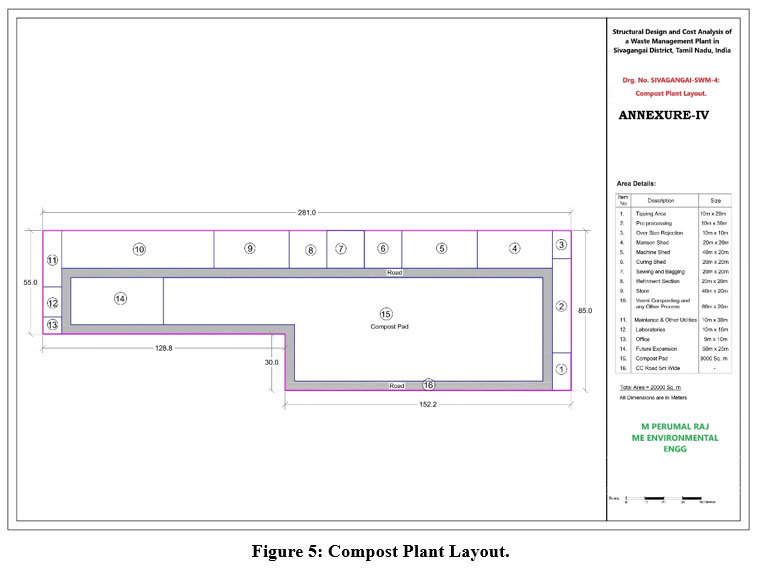 | Figure 5: Compost Plant Layout.
|
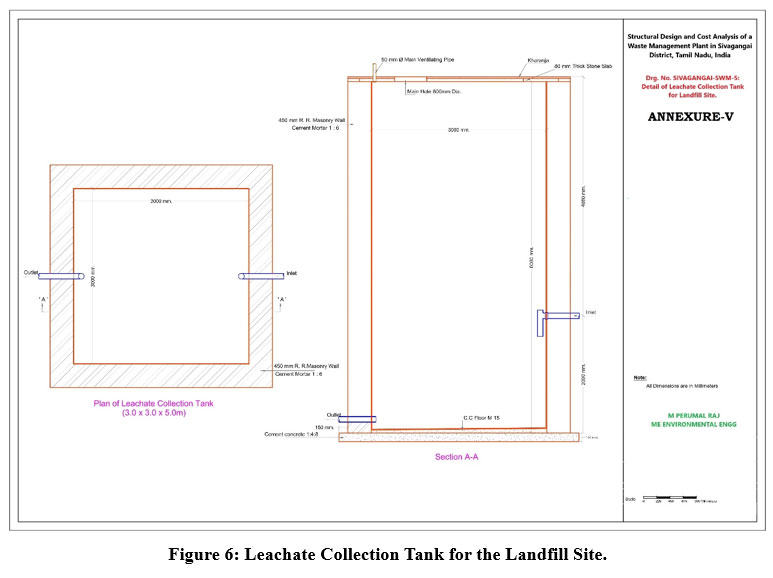 | Figure 6: Leachate Collection Tank for the Landfill Site.
|
The relevant drawing, Fig. 6, details the leachate collection tank for the landfill site. This facility is designed to effectively manage and treat leachate, drawing inspiration from the Kodungaiyur Dump Yard.
The relevant drawings illustrating the landfill design include Fig. 7, which shows the cross-section of the landfill site, and Fig. 8, which details the side bund anchor trench. The sanitary landfill adheres to Central Pollution Control Board ( CPCB) guidelines and incorporates a geomembrane lining system similar to that used at the Ghazipur Landfill to prevent environmental contamination. Each component integrates specific elements from the respective drawings to ensure efficient plant operation, minimize environmental impact, and comply with regulatory requirements.
The trench's inner side (1V:3H, 3.60 m) provides structural stability, preventing soil erosion and ensuring proper drainage within the landfill system. The inner side of the bund (1V:3H, 9 m) is designed to retain waste material while allowing for adequate slope stabilization, thus preventing landslides or bund failure. The top of the bund (9.0 m wide) serves as a working platform for machinery and personnel, facilitating access to various landfill sections and placing waste layers. The outer side of the bund (1V:2H, 6 m) is sloped to effectively manage runoff, minimizing surface erosion risks while maintaining the integrity of the bund during heavy rainfall. Additionally, a stormwater drain is installed to collect and channel excess water from rainfall, preventing surface water from mixing with waste material and reducing the risk of leachate formation.
Each component works in concert to ensure that the landfill site operates efficiently, reduces environmental impact, and complies with the regulatory guidelines for safe waste management.
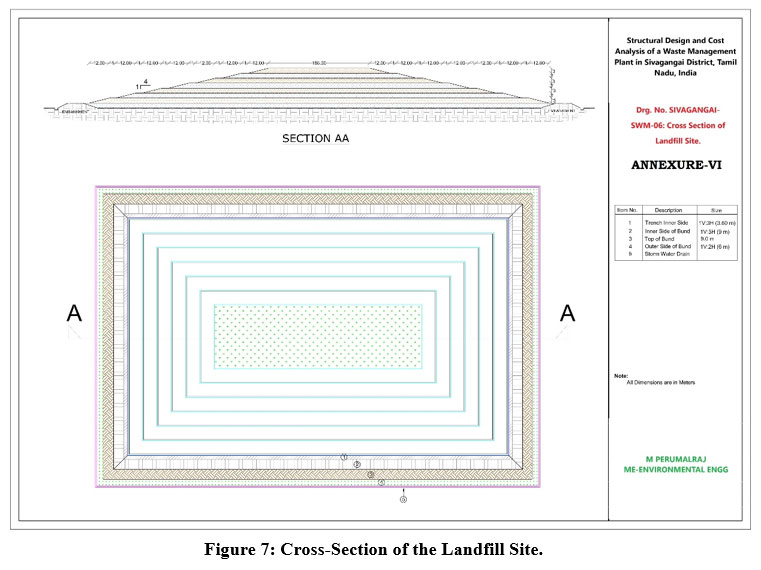 | Figure 7: Cross-Section of the Landfill Site.
|
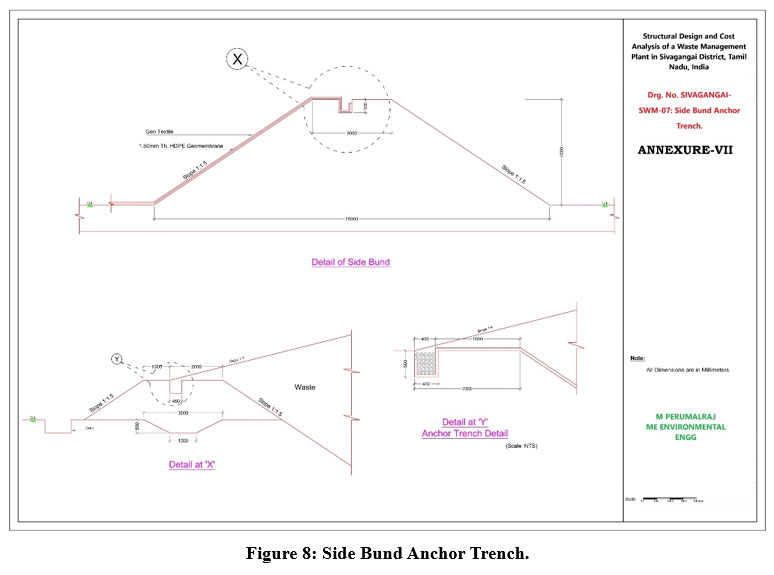 | Figure 8. Side Bund Anchor Trench.
|
Material Recovery Facility (MRF) Design
MRF is based on the structure of the MRF at the Okhla Waste Plant in Delhi. It includes:
Sorting Conveyor Belts: These are for automated waste sorting based on waste recovery facility designs used in South Korea.
Baling Machines: These are based on models installed at Singapore's waste processing plants.
Storage Bays: Adapted from Pune’s sorting facility, with separate bays for paper, plastic, metal, and glass.
Composting Unit Design
The composting section mirrors the setup in Coimbatore’s Biogas Plant. The design includes:
Windrow Composting Pits: 3m wide and 2m deep pits, covered with temporary roofing.
Aeration and Turnover Equipment: Based on Pune’s municipal composting facility design.
Organic Waste Receiving Area: Inspired by the zero-waste model from Kerala's waste management system.
Leachate Treatment System
The leachate treatment system is based on the design implemented at Kodungaiyur, Chennai. It includes:
Sedimentation Tanks: For solid-liquid separation.
Filtration and Aeration Systems: These are based on technologies used at landfill sites in Gujarat.
Chemical Treatment Units: These are used to treat hazardous chemicals in the leachate.
Landfill Design
Like the Delhi Sanitary Landfill, sanitary landfills are designed with a geomembrane liner and gas management system. This design ensures environmental protection and effectively manages methane gas emissions.
Selecting a suitable area for a waste management plant in Sivagangai District requires consideration of several factors:
Proximity to Waste Sources: The plant should be close to major urban centers like Sivagangai, Karaikudi, and Devakottai to minimize transportation costs and environmental impact.
Land Availability: Adequate land is needed to accommodate various plant components (e.g., sorting areas, composting units, leachate treatment facilities). Typically, a waste management plant requires 10-15 acres of land.
Accessibility: The site should be easily accessible by major roads for waste transportation. Road quality and traffic patterns should be considered.
Environmental Impact: The site should be located away from residential areas, water bodies, and ecologically sensitive zones to reduce potential adverse impacts on local communities and wildlife.
Topography and Drainage: The land should have suitable topography and drainage to avoid waterlogging issues and facilitate efficient construction.
Soil Conditions: Conduct soil tests to ensure the ground is suitable for construction and to evaluate the potential for leachate contamination.
Regulatory Compliance: Ensure the selected site complies with local zoning regulations and environmental standards.
Suggested Locations
Based on these criteria, potential areas for the waste management plant in Sivagangai District might include:
Near Sivagangai Town: Areas on the outskirts of Sivagangai Town where land is relatively flat and accessible.
Around Karaikudi: Land near Karaikudi, as it is a significant urban center and has available land for development.
Peripheral Rural Areas: Sites away from densely populated areas but still within reasonable transport distance to urban centers.
Site Evaluation Criteria
Size: Ensure the site has at least 10-15 acres for the setup.
Access: Check road connectivity and ease of access for waste collection vehicles.
Environmental Impact: Assess the impact on local ecosystems and communities.
Soil and Drainage: Ensure the site has suitable soil conditions and good drainage.
Results and Discussion
Waste Generation Projection Analysis
Based on the current waste generation rate of approximately 150 tons per day (TPD) and an estimated annual population growth rate of about 2%, the projected waste generation in Sivagangai District over the next decade is expected to increase to approximately 180–200 TPD. This projected growth necessitates a scalable plant design. Accordingly, the proposed waste management facility incorporates modular composting units and reserved land for future expansion to accommodate increased waste volumes without significant structural modifications.
Cost Comparison with Existing Indian Plants
A comparative evaluation was conducted to assess the economic feasibility of the proposed facility. The estimated capital cost of Rs. 3.6 crores for a 150 TPD integrated waste management plant is economically competitive when compared to similar facilities in cities such as Pune and Coimbatore, where reported costs typically range between Rs. 3.5– Rs5 crores depending on land value, technology selection, and infrastructure components. The cost efficiency of the proposed model is attributed to optimized layout planning, phased construction scheduling, and the adoption of scaled engineering adaptations from established facilities.
Environmental Impact Reduction Assessment
The integration of composting and material recovery systems is projected to divert approximately 60–70% of total waste from landfill disposal. This diversion significantly reduces environmental burden and extends landfill life. Furthermore, methane capture and compost production are estimated to reduce greenhouse gas emissions by approximately 20–25% compared to existing open dumping practices in the district. These interventions contribute to climate change mitigation, improved groundwater protection, and enhanced environmental sustainability.
Construction Planning for the Waste Management Plant
Project Overview
The proposed waste management facility is designed with a processing capacity of approximately 150 TPD and includes the following major components:
Material Recovery Facility (MRF)
Composting Unit
Anaerobic Digestion/Biogas Unit
Leachate Collection and Treatment System
Administrative and Staff Facilities
The plant is planned for Sivagangai District, Tamil Nadu, India, with integrated systems to ensure efficient waste segregation, treatment, and resource recovery.
Phased Construction Approach
The project implementation is structured into seven phases to ensure systematic development and efficient resource utilization.
Phase 1: Pre-Construction Activities (1–2 Months)
This phase includes site survey, land acquisition finalization, geotechnical investigation for foundation design, securing environmental clearances from TNPCB and MoEF&CC, finalization of structural and MEP designs, and procurement of required permits and licenses.
Phase 2: Site Preparation (2–3 Months)
Activities include site clearing, leveling, temporary utility installation, and construction of access roads for material and equipment transportation.
Phase 3: Foundation and Civil Works (4–5 Months)
This stage involves excavation, reinforced concrete foundation construction, structural frame erection, and installation of leachate collection systems.
Phase 4: Structural and Mechanical Installation (5–6 Months)
Construction of plant buildings is completed, followed by installation of conveyor systems, composting equipment, anaerobic digesters, leachate treatment units, and electrical automation systems.
Phase 5: Infrastructure Development (3–4 Months)
Internal roadways, landscaping buffer zones, rainwater harvesting systems, water recycling systems, and security infrastructure are developed during this phase.
Phase 6: Testing and Commissioning (2–3 Months)
Mechanical, electrical, and leachate systems are tested for operational efficiency. Staff training is conducted, and environmental compliance verification is completed.
Phase 7: Full Operational Handover (1 Month)
Final inspections are carried out, documentation is completed, and full-scale plant operations commence.
Table 1: Proposed Construction Schedule
Phase | Duration | Completion Timeline |
Phase 1: Pre-Construction | 1–2 Months | Month 1–2 |
Phase 2: Site Preparation | 2–3 Months | Month 3–5 |
Phase 3: Foundation and Civil Work | 4–5 Months | Month 6–10 |
Phase 4: Structural & Mechanical Work | 5–6 Months | Month 11–16 |
Phase 5: Infrastructure Development | 3–4 Months | Month 17–20 |
Phase 6: Testing and Commissioning | 2–3 Months | Month 21–23 |
Phase 7: Operational Handover | 1 Month | Month 24 |
Cost Analysis
The cost estimation is derived from scaled adaptations of established waste management facilities, incorporating regional construction costs in Tamil Nadu. The estimates include capital costs for civil works, machinery, and initial operational requirements.
Table 2: Civil Works Cost Estimate
Component | Reference Location | Cost Estimate (INR) |
Land Acquisition (10 acres) | Pune Municipal Plant | 50,00,000 |
Earthworks | Coimbatore Composting Plant | 15,00,000 |
Foundation and Structures | Okhla Waste Plant | 1,20,00,000 |
Roofing and Finishing | Pune Plant | 40,00,000 |
Table 3: Machinery and Equipment Cost
Equipment | Reference Location | Cost Estimate (INR) |
Conveyor System | Okhla Waste Plant | 30,00,000 |
Baling Machine | Singapore Waste Plant | 25,00,000 |
Composting Machinery | Coimbatore Compost Plant | 10,00,000 |
Leachate Treatment Equipment | Kodungaiyur Plant | 20,00,000 |
Table 4: Operational Costs (Annual)
Operational Aspect | Reference Location | Cost Estimate (INR/Year) |
Labor Costs | Pune Waste Facility | 25,00,000 |
Maintenance and Repairs | Okhla Waste Plant | 15,00,000 |
Energy Costs | Pune Compost Plant | 10,00,000 |
Total Estimated Capital Cost: 3,60,00,000
Note: Cost estimates are approximate and based on scaled adaptation of reference facilities.
Sustainability Considerations
The proposed design integrates environmentally sustainable technologies, including solar power systems for operational energy efficiency, rainwater harvesting units to reduce freshwater consumption, and methane capture systems integrated with biogas generation units. These measures collectively reduce environmental impact while enhancing long-term operational sustainability.
Future Scope of Solid Waste Management in Sivagangai
As future expansion, incorporation of advanced waste-to-energy technologies such as controlled incineration systems may be considered. Such systems would include pre-treatment units, high-temperature combustion chambers with insulated walls, air pollution control devices including electrostatic precipitators and scrubbers, and heat recovery units for energy generation. These technologies would further reduce landfill dependency and enhance energy recovery potential, provided strict environmental compliance standards are maintained.
Conclusion
The present study demonstrates the technical and economic feasibility of establishing a 150 TPD integrated waste management plant in Sivagangai District, Tamil Nadu. The proposed facility incorporates a Material Recovery Facility (MRF), composting unit, anaerobic digestion system, sanitary landfill with methane management, and a leachate treatment system to ensure environmentally sound waste processing.
The estimated capital investment of Rs. 3.6 crores indicates that the project is economically viable when compared to similar facilities in other Indian cities. The phased construction strategy enhances implementation efficiency, reduces financial risk, and allows systematic monitoring of progress.
Environmental assessment indicates that the integration of material recovery and composting systems could divert approximately 60–70% of waste from landfill disposal, while methane capture and biogas recovery contribute to greenhouse gas emission reduction. These measures significantly improve environmental sustainability, groundwater protection, and public health outcomes in the district.
The plant design incorporates scalability features, enabling future expansion to accommodate projected increases in waste generation. With an estimated land requirement of approximately 10 acres for a 150 TPD facility, the layout ensures optimized land utilization while maintaining operational efficiency and regulatory compliance.
Overall, the study confirms that an integrated engineering design combined with structured financial planning can provide a practical and sustainable waste management solution for medium-scale districts. The favorable cost-to-capacity ratio and projected waste diversion efficiency demonstrate strong environmental and economic advantages over conventional open dumping practices.
Acknowledgement
The authors would like to thank Alagappa Chettiar Government College of Engineering and Technology, Karaikudi, for providing academic and technical support to carry out this research work. The authors also acknowledge the Tamil Nadu Pollution Control Board (TNPCB) for providing regulatory guidelines related to solid waste management facilities. The valuable insights from municipal waste management officials of Sivagangai District are gratefully appreciated.
Funding Sources
The author(s) received no financial support for the research, authorship, and/or publication of this article.
Conflict of Interest
The authors do not have any conflict of interest.
Data Availability Statement
The manuscript incorporates all datasets produced or examined throughout this research study.
Ethics Statement
This research did not involve human participants, animal subjects, or any material that requires ethical approval.
Informed Consent Statement
This study did not involve human participants, and therefore, informed consent was not required.
Permission to Reproduce Material from Other Sources
Not Applicable.
Author Contributions
Perumal Raj Manikandan: Conceptualization, Methodology, Plant Design Planning, Cost Estimation,Data Analysis, Writing – Original Draft, Review and Editing, Final Approval.
Ramaiah Prakash: Conceptualization, Methodology, Plant Design Planning, Cost Estimation, Data Analysis, Writing – Review and Editing, Final Approval.
Sundaresan Srividhya: Data Collection, Validation, Visualization, Supervision, Writing – Review and Editing, Final Approval.
References
- Annepu RK. Sustainable solid waste management in India. New York: Columbia University; 2012.
- Bogner J, Abdelrafie Ahmed M, Diaz C, Faaij A, Gao Q, Hashimoto S, et al. Mitigation of global greenhouse gas emissions from waste: conclusions and strategies. Mitig Adapt Strateg Glob Change. 2008;13:441-464.
- Central Pollution Control Board. Status of municipal solid waste management in India. New Delhi: Ministry of Environment, Forest and Climate Change; 2020.
- Central Pollution Control Board. Annual report on solid waste management in India 2022-23. New Delhi: CPCB; 2023.
- Chandran R, Arockiasamy G. Challenges of solid waste management in Tamil Nadu: policy and practice gaps. Int J Environ Res Dev. 2021;9(4):345-359.
- Eurostat. Recycling rates for municipal waste in European countries. Luxembourg: European Statistical Office; 2020.
- Guerrero LA, Maas G, Hogland W. Solid waste management challenges for cities in developing countries. Waste Manag. 2013;33(1):220-232.
CrossRef - Gupta S, Krishna S, Kulshreshtha A, et al. Integrated solid waste management in Pune: a case study. Waste Manag Res. 2018;36(7):645-653.
- Hoornweg D, Bhada-Tata P. What a waste: a global review of solid waste management. Washington, DC: World Bank; 2012.
CrossRef - Intergovernmental Panel on Climate Change. Climate change 2021: the physical science basis. Cambridge: Cambridge University Press; 2021.
- International Renewable Energy Agency. Waste-to-energy technologies for sustainable development. Abu Dhabi: IRENA; 2019.
- Kaza S, Yao L, Bhada-Tata P, Van Woerden F. What a waste 2.0: a global snapshot of solid waste management to 2050. Washington, DC: World Bank; 2018.
CrossRef - Kumar A, Singh P, Ranjan R. Water conservation techniques in waste management: Indian case studies. J Environ Sci Eng. 2021;45(2):123-131.
- Kumar S, Smith SR, Fowler G, Velis C, Kumar SJ, Arya S, et al. Challenges and opportunities associated with waste management in India. R Soc Open Sci. 2017;4(3):160764.
CrossRef - Ministry of Environment, Forest and Climate Change. National action plan on climate change: progress and future pathways. New Delhi: Government of India; 2022.
- Rajagopal D, Chandran R, Kumar S. Energy recovery from organic waste: a case study of Coimbatore biogas plant. J Sustain Energy Environ. 2020;11(3):145-154.
- Ranjan A, Chopra S. Solid waste management: lessons from global best practices. Indian J Environ Manage. 2020;27(1):45-58.
- Sharma N, Goyal R. Health and environmental risks associated with open dumping of solid waste in India: a review. J Environ Health Stud. 2020;10(3):95-105.
- Sivagangai District Administration. District waste management report. Tamil Nadu: Government of Tamil Nadu; 2021.
- Sundaravadivel M, Ramasamy P, Murugan G. Waste management challenges in Tamil Nadu. Tamil Nadu J Environ Sci. 2019;5(2):122-134.
- Tamil Nadu Pollution Control Board. Guidelines for solid waste management facilities. Chennai: TNPCB; 2022.
- United Nations Environment Programme. Global waste management outlook 2024. Nairobi: UNEP; 2024.
- World Bank. Global waste management trends and future projections. Washington, DC: World Bank; 2025.